Capt.U.S. Army · 82nd Airborne · 9th Infantry Division
Track & field · 100 m · 4×100 m relay
b. 31 Oct 1937 · Atlanta, Georgia
Twice the Army pulled him out of a war to run for the United States, and twice it sent him back.
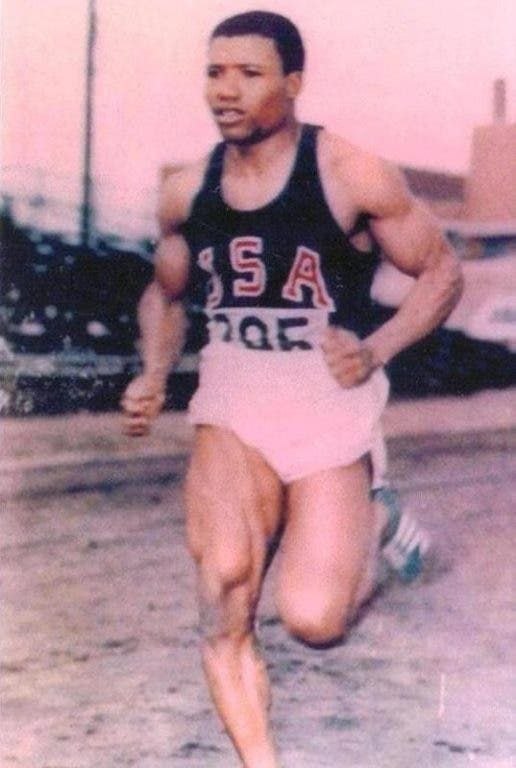
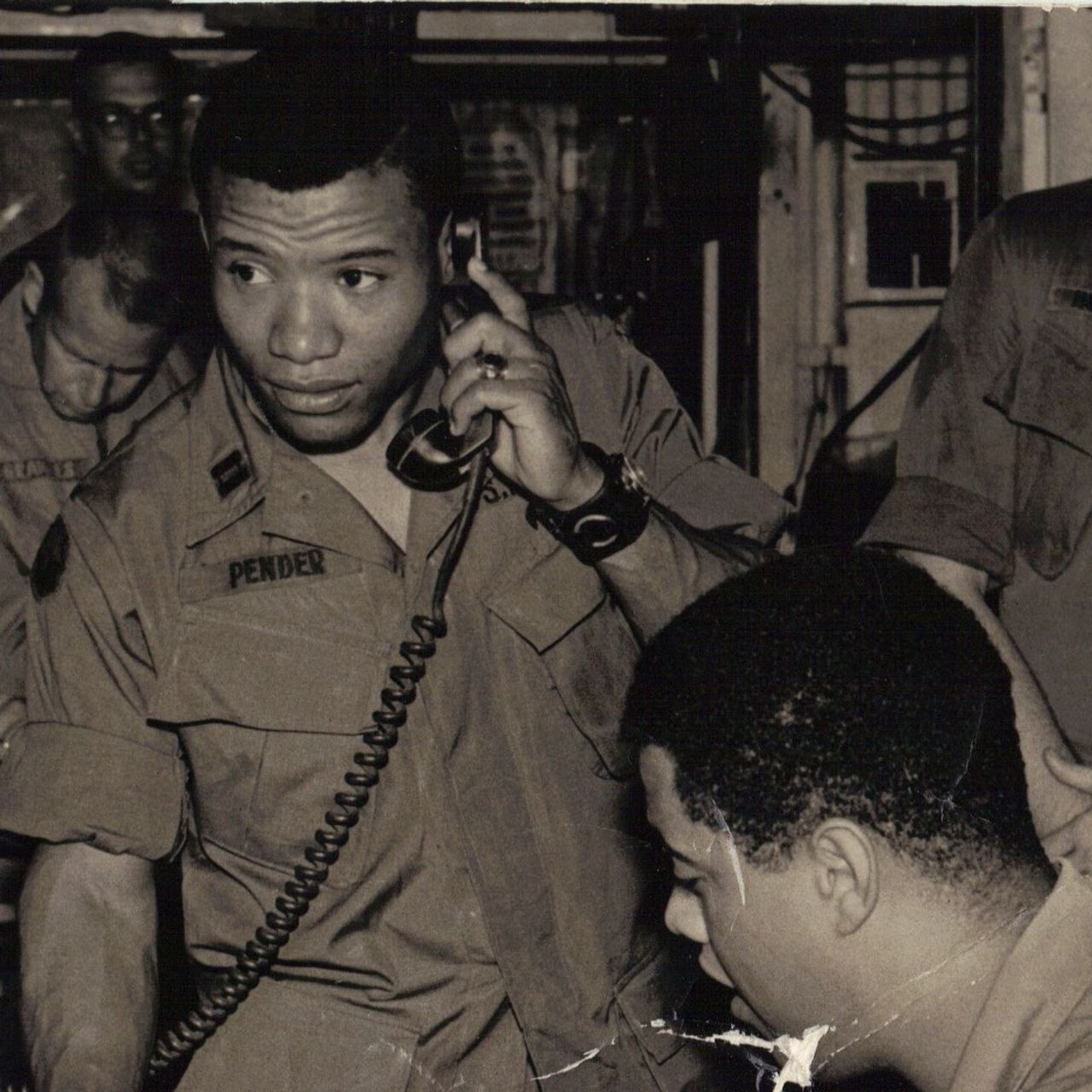
TWO UNIFORMS
In the USA singlet, bib 295 · Mexico City, 1968Capt. Pender on a field telephone · Vietnam
1968 · The crossroads
In 1968 every Black American athlete of standing was asked what he owed a country that had not yet kept its promise to him. Mel Pender and Lew Alcindor gave opposite answers in the same year — and both answers cost them something.
Capt. Mel Pender
Served. Taken out of the Mekong Delta to run, and sent back to it.
Kevin Clark collection

Kareem Abdul-Jabbar
Refused. As Lew Alcindor he would not go to Mexico City at all.
Frame from Kevin Clark's film
Pender ran his relay four days after Tommie Smith and John Carlos raised their fists on the 200 metres podium. Mexico City is where the question got asked out loud — and the men who answered it did not agree.
Smith and Carlos answered on the podium on 16 October, and were expelled from the Games for it. Alcindor answered by staying away, in solidarity with the Olympic Project for Human Rights. Muhammad Ali had answered eighteen months earlier and was still paying for it: stripped of the heavyweight title the day he refused induction in April 1967, convicted that June, and out of boxing until October 1970.
Capt. Pender answered in uniform. He had been taken out of the Mekong Delta to run, he ran the second leg of the fastest 4×100 metres relay yet run, and then he went back to the war.
A generation earlier Joe Louis had answered a third way — from inside the ranks, using his standing as champion to open Officer Candidate School to Black soldiers at Fort Riley. The class that followed included 2nd Lt. Jackie Robinson.
Service record

82nd Airborne Division
Shoulder sleeve insignia · his first eleven years, enlisted
- 01
Enlisted at seventeen · assigned to the 82nd Airborne Division on Okinawa in 1960 · Officer Candidate School 1965 · two tours in Vietnam with the 9th Infantry Division in the Mekong Delta · twenty-one years in the U.S. Army
- 02
Pulled out of combat in 1967 to train for the Mexico City Games, and returned to Vietnam after winning gold
- 03
Bronze Star, Combat Infantry Badge, Joint Service Commendation Medal and Vietnam Service Medal · retired as a captain, 1976 · afterwards assistant and then head track coach at West Point
The race
20 Oct 1968 · Mexico City
38.24
World record
- Charlie Greene
- Mel Pender — second leg
- Ronnie Ray Smith
- Jim Hines
Did you know
In the Mexico City final he ran the second leg — Charlie Greene led off, Pender second, Ronnie Ray Smith third, Jim Hines anchoring — and they finished in 38.24 seconds, a world record. He reached the Olympic 100 m final twice, in 1964 and 1968, and placed sixth both times; the first of those he ran injured.
BIRTHDAY
October 31
FOR RESEARCH PROJECTS
Observances
- NOV 11Veterans Day
- LAST MON · MAYMemorial Day
Personal timeline · birth → service → career → honors
31 Oct 1937
Born in Atlanta, Georgia.
c. 1954–55
Enlists in the U.S. Army at seventeen. [verify: sources give 1954 and 1955]
1954/55–1965
Serves his first eleven years enlisted, with the 82nd Airborne Division — stationed on Okinawa in 1960.
1964
Reaches the 100 m final at the Tokyo Olympics and runs it injured, finishing sixth (tied). He does not start the relay.
1965
Graduates Officer Candidate School.
1965–68
Two tours in Vietnam, with the 9th Infantry Division in the Mekong Delta.
1967
Pulled out of Vietnam to train for the Mexico City Games.
20 Oct 1968
Runs the second leg of the 4×100 m relay final — gold, and a world record of 38.24. His gold is the relay: in the 100 m final he placed sixth in 10.17, the race Jim Hines won in 9.95.
after 1968
Returns to Vietnam. Awarded the Bronze Star.
Aug 1970
Returns to the United States.
1976
Retires from the Army as a captain after twenty-one years.
after 1976
Assistant, then head track coach at the United States Military Academy, West Point.
The archive · from Kevin Clark’s collection
Pender in uniform.
Two prints from Kevin Clark's collection — the USA singlet at Mexico City in 1968, and Capt. Pender on a field telephone in Vietnam. Shown at the size they were scanned, and never enlarged.
Related films · Kevin Clark's channel
Mel Pender on film.
Sources for this dossier
- 01Olympedia — Mel Pender (authoritative Olympic results)
- 02Library of Congress, Veterans History Project — Melvin T. Pender Jr. collection
- 03Sky Sports — Mel Pender's story of serving in Vietnam and winning Olympic gold in 1968
- 04Sky Sports News (video) — “From the Vietnam War to Olympic champion”
- 05Runner's Gazette — “Soldier-Athlete Mel Pender: Olympic Gold Medalist”
Anything marked [verify] has not yet been confirmed against a primary source. Full ledger on the Scholars page.